
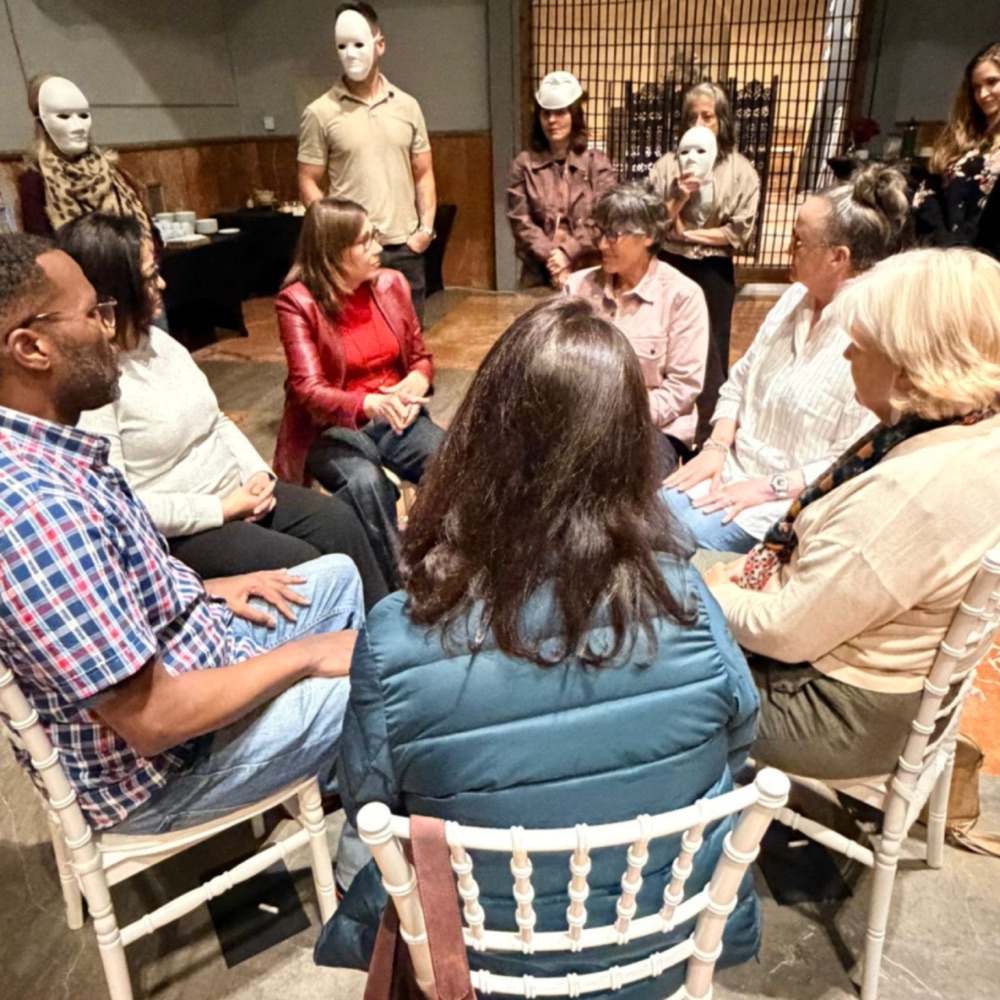
Last month I played a game designed by four colleagues, Dr. David Yudis, Nicky Brown, Dr. Sarah Madigan and Varian C. Brandon, in Rich Litvin’s 4PC community.
Not a challenge. A predicament.
Rich makes that distinction precisely. A challenge pushes you out of your comfort zone. A predicament questions your identity.
This one did exactly that.
I was chosen to be a traitor.
Small group. Hidden team. And something unexpected happened immediately.
A strong sense of belonging. Even though the role was built on betrayal, I felt loyal. Genuinely loyal. To that small team.
At the end, there was a choice: win individually for a higher prize, or win as a team. It didn’t even cross my mind to choose the individual option.
That stayed with me. Because in business, we assume people will follow the highest incentive. The truth is, they often don’t. They also act from the desire to belong. To stay connected to their team, even when the incentives point elsewhere.
Loyalty is contextual.
During the game, I was on the opposite side from my business partner Alina Addison. She experienced my actions during the game as betrayal. Understandably.
But here is the question: was I disloyal to her? Or was I loyal to the team I was part of in that specific context?
Both can be true simultaneously.
This is where many leadership conflicts sit. We judge behaviour without accounting for context. Someone leaves your firm for a competitor. Your perception of their character may still be valid. But the context has changed. They are now playing a different game.
Three questions that can sharpen your thinking:
- What formed my perception of this person?
- Has the context changed?
- What game are we each playing right now?
Most mistakes happen when we only answer the first question.
Intuition and bias sound identical from the inside.
What surprised me most was the perception of intuition.
We were a room of experienced coaches. Decades of behavioural and leadership work between us. Several were psychologists.
People kept saying: my intuition says this person is a traitor.
From the outside, it was clear. It wasn’t intuition. It was bias. Group influence. The need to belong.
There is research on trading floors: the most successful intuitive traders are those who can accurately track their own heartbeat, not metaphorically, literally. Their edge is not thinking better. It is feeling more precisely what is happening in their body.
If you cannot distinguish those signals internally, you will call all of them intuition.
Emotion can make you forget which game you are playing.
Inside the traitors game, there were games within the game. Designed to trigger.
In one of them, I got emotionally pulled in. For a moment, I forgot the bigger game I was playing. And I reacted. That reaction almost exposed me.
I managed to turn it around. But the lesson stayed.
I see this constantly in corporate environments. Someone says something. Your value feels questioned. Your identity gets touched. And you react. The reaction feels justified. But it damages the bigger game, the relationship, the trust you spent months and even years building.
Before you respond: pause. Breathe. Ask yourself what game you are actually playing. And whether this reaction serves it.
Identity is not fixed. Range is power.
I have always seen myself as someone whose emotions show on their face. That is true.
Until something really matters. Then I can hide them.
Being chosen as traitor was a direct challenge to that identity. I was surrounded by highly perceptive coaches who know me well. The question was simple: would they see it?
They didn’t.
And what is interesting is how I used my own identity as a tool. When it was suggested I might be the traitor, I said: you would see it on my face.
Which is true. And also incomplete. I used a known version of myself to reinforce their bias.
Most leaders operate from a fixed identity. I am direct. I am emotional. I am not political.
Useful. And limiting.
Because you are not one thing. You are a range. The more aware you are of that range, the more choice you have in how you show up. In high-stakes environments, range is a strategic advantage.
Genuine vulnerability redirects a room.
As a traitor, I had lunches with the faithfuls. Informal conversations. Unstructured time. These were the moments of highest exposure outside of the formal game.
What I noticed: when I shared something genuinely personal, real, not performative, the dynamic shifted. The conversation moved from analysing the game to holding space for me as a human. It built trust. It deepened connection. And it redirected attention.
Vulnerability is often misunderstood in leadership. It is not oversharing. It is not losing control.
When it comes from a real place, it creates connection without weakening your position. It can diffuse tension, build trust quickly, shift the focus of a room.
But only if it is real. People feel the difference.
The instinct that makes you visible can also expose you.
I enjoy being at the centre of attention. That is part of how I naturally operate.
As a traitor, that instinct was a liability. Visibility increases risk. So I had to do the opposite, step back, say less, not pull attention toward myself.
And I noticed something unexpected. I enjoyed it.
Many leaders overuse their strengths. The decisive leader decides too quickly. The articulate leader speaks too much. The driven leader pushes too hard.
Not because the strength is wrong. Because it is applied automatically.
Range means you can access your strength. And you can choose not to use it.
That is control. That is maturity. That is leadership.
The pattern connecting all of it:
You don’t lose impact because you lack capability.
You lose it because in the moment that matters, you default to one identity, react instead of choosing, play the wrong game, or use your strength in the wrong dosage.
It shows up as over-proving, over-explaining, moving too fast or stepping in too early. Not because you are not good enough. Because your intensity is slightly off in the moment that matters.
The work is not to become someone else.
It is to expand who you already are, and to choose, consciously, who shows up when it counts.
With love,
Tatiana